Oil, Sanctions, and the Tenge: What US Energy Policy Really Means for Central Asian Forex Traders
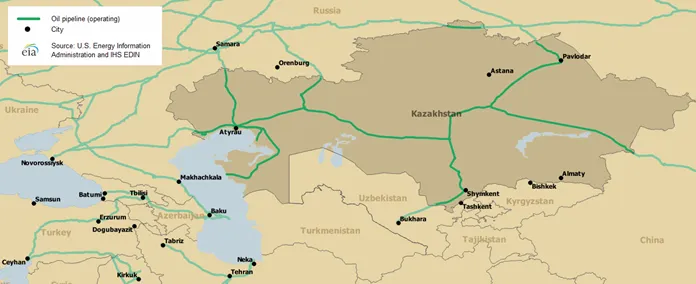
Photo: U.S. Energy Information Administration, Public domain, via Wikimedia Commons
For most American forex traders, Kazakhstan registers as little more than a geographic curiosity — a landlocked nation somewhere east of the Caspian. Yet for anyone who trades energy-correlated currencies, the Kazakhstani tenge (KZT) represents one of the more transparent commodity-driven instruments available in emerging-market forex. The reason is straightforward: Kazakhstan sits atop some of the world's largest proven oil reserves, and crude exports account for a dominant share of the country's export revenue and government receipts. When energy markets shift — whether because of a Washington policy decision, an OPEC communiqué, or a geopolitical disruption in a distant refinery corridor — the tenge tends to follow, often with a predictability that more crowded currency pairs simply cannot offer.
This analysis is designed specifically for US-based traders who already understand how energy markets work but have not yet connected those dynamics to Central Asian forex positioning.
The Structural Link Between Crude and the Tenge
Kazakhstan produces roughly 1.5 to 1.8 million barrels of oil per day, much of it extracted from the Tengiz, Kashagan, and Karachaganak fields. The country's National Fund, which acts as a sovereign wealth buffer, is capitalized largely through hydrocarbon revenues. The National Bank of Kazakhstan (NBK) manages the tenge within a managed float framework, intervening periodically when currency volatility threatens macroeconomic stability.
The practical consequence for traders is that Brent crude prices serve as a reliable leading indicator for tenge direction. Research tracking tenge movements against Brent over rolling 90-day windows consistently shows correlation coefficients above 0.70 during periods of price trending. When Brent climbs above $85 per barrel, the NBK typically faces reduced pressure to defend the tenge, allowing it to appreciate modestly. When crude falls sharply — as it did during the COVID-19 demand collapse in 2020 and again during the mid-2022 correction — the tenge weakens in a manner that is both swift and measurable.
How US Energy Sanctions Create Forex Ripples
Here is where American policy becomes directly relevant to KZT positioning. The United States has deployed energy sanctions with increasing frequency over the past decade — against Russia, Iran, Venezuela, and various intermediary entities. Each of these actions reshuffles global crude supply chains in ways that affect Kazakhstan specifically.
The Russia-Ukraine conflict and the subsequent Western sanctions package on Russian energy exports offer the clearest recent case study. As European buyers scrambled to diversify away from Russian crude, Kazakhstan's export routes and pricing power shifted materially. The Caspian Pipeline Consortium (CPC), which carries the bulk of Kazakhstani crude to the Black Sea terminal at Novorossiysk, runs through Russian territory — a geopolitical chokepoint that became acutely relevant when sanctions rhetoric intensified. In the months following the initial sanctions announcement in early 2022, the tenge experienced sharp depreciation followed by a partial recovery, tracing a path that correlated with both crude price volatility and the evolving CPC transit risk premium.
For traders monitoring US Treasury Office of Foreign Assets Control (OFAC) announcements alongside Brent price action, that sequence was not random noise — it was a readable signal.
OPEC Decisions as a Transmission Mechanism
Kazakhstan is a member of the OPEC+ alliance, which means production quota decisions made in Vienna directly constrain or expand the country's export capacity. When OPEC+ announces cuts — as it did in April 2023, surprising markets with a voluntary reduction of roughly 1.66 million barrels per day — the tenge tends to receive a short-term boost as Brent rallies on supply restriction expectations.
However, the relationship is not always linear. Kazakhstan has a documented history of exceeding its OPEC+ production quotas, which creates a secondary dynamic: diplomatic friction within the alliance that can introduce uncertainty into the tenge's trajectory. When Kazakhstan's overproduction triggers compensatory cut demands from Saudi Arabia or Russia, traders face a more complex calculus — higher spot crude prices offset partially by geopolitical risk premiums embedded in KZT positioning.
US traders who follow OPEC+ meeting calendars and track Kazakhstan's actual production figures (published monthly by the Ministry of Energy) can develop a nuanced view of these crosscurrents before they fully price into the currency.
Domestic US Energy Policy: The Less-Obvious Channel
Beyond sanctions and OPEC dynamics, US domestic energy policy transmits into the tenge through the global dollar cycle. When the US expands domestic oil production — as shale output surged during the 2014–2019 period — downward pressure on global crude prices ultimately weakens commodity-currency exporters like Kazakhstan. Conversely, when US regulatory shifts constrain domestic output, the resulting supply gap tends to support Brent, providing indirect tailwinds for the tenge.
The Biden administration's pause on new federal oil and gas leasing in January 2021, for example, contributed to a longer-term tightening of global supply expectations that supported crude prices through 2022. While the tenge's appreciation during that period was influenced by multiple factors, the supply-side contribution from reduced US leasing activity was a meaningful input into the commodity price environment that supported KZT.
More recently, debates in Washington over LNG export terminal approvals and Strategic Petroleum Reserve release decisions have created short-duration volatility events that attentive traders can position around — particularly in the 48-to-72-hour windows surrounding major policy announcements.
Building a Practical Trading Framework
For US-based traders looking to incorporate tenge exposure into an energy-correlated strategy, the following framework offers a starting structure:
Monitor Brent crude as the primary leading indicator. Set price alerts at key technical levels — $75, $85, and $95 per barrel — and treat breaches of these thresholds as potential tenge inflection signals.
Track OFAC and State Department energy-related announcements. New sanctions designations affecting Russian, Iranian, or Venezuelan crude supply chains have historically created measurable tenge volatility within two to five trading sessions.
Watch the OPEC+ meeting calendar. The months of March, June, September, and December tend to carry the highest probability of production decision surprises. Position sizing should reflect elevated uncertainty during these windows.
Incorporate Kazakhstan's monthly production reports. When actual output deviates significantly from quota commitments, expect diplomatic commentary from OPEC+ partners, which can introduce additional short-term tenge volatility.
Account for the NBK intervention threshold. The National Bank of Kazakhstan has historically intervened when the tenge depreciates beyond approximately 15 to 20 percent within a calendar year. Understanding this implicit floor helps traders calibrate downside risk in short KZT positions.
The Opportunity Within the Complexity
Energy-correlated forex trading demands a more layered analytical approach than trading major currency pairs, but that complexity is precisely where the opportunity resides. The tenge's structural dependence on crude revenues means that traders who invest in understanding US energy policy — a domain American investors are already well-positioned to analyze — gain a meaningful informational edge over market participants who approach KZT as an opaque emerging-market instrument.
At ForexKZ, our regional presence and data infrastructure are specifically designed to help traders bridge that analytical gap, connecting the policy signals emanating from Washington and Vienna to the price movements unfolding in Almaty. For traders willing to look beyond the dollar-euro axis, the tenge's oil-backed dynamics offer a compelling and underexplored frontier.