Priced to Perfection: How the Tenge's Volatility Surface Is Leaving US Options Traders Flat-Footed
American options traders have spent the better part of the last decade chasing volatility wherever it surfaces — from meme-stock eruptions to Federal Reserve press conferences. Yet a genuinely distinctive volatility regime has been quietly operating in Kazakhstan's currency markets, largely unnoticed by the institutional desks and retail platforms that dominate US trading culture. The Kazakhstan tenge (KZT) does not behave like the Mexican peso, the South African rand, or any of the other emerging-market currencies that US traders typically reach for when they want exotic exposure. It behaves like itself — and that distinction matters enormously when you are building an options position.
Why the Tenge's Volatility Profile Defies the Standard EM Template
Most emerging-market currencies share a common volatility signature: they spike sharply during global risk-off episodes, recover gradually, and spend long stretches in relatively compressed implied volatility (IV) environments between crises. The tenge does something different. Because Kazakhstan's economy is anchored to commodity export cycles — crude oil from the Tengiz and Kashagan fields, uranium, copper, and ferroalloys — the currency's realized volatility tends to cluster around commodity price inflection points rather than purely global sentiment shifts.
This means the tenge can remain dormant during periods when other EM currencies are moving aggressively, and then register sharp, directional moves when oil benchmarks cross key technical levels or when Kazakhstan's National Bank of Kazakhstan (NBK) adjusts its intervention posture. For an options trader accustomed to pricing volatility against a backdrop of correlated EM behavior, this decoupling is not a nuisance — it is an opportunity.
Historical realized volatility data for USD/KZT over rolling 30-day windows shows a pattern of extended low-volatility consolidation punctuated by compressed but high-magnitude bursts. The 2020 oil shock, for instance, produced a realized volatility spike in USD/KZT that briefly exceeded comparable moves in USD/RUB on a percentage basis, yet the event received virtually no coverage in US financial media. Options that were cheap going into that period — because implied volatility had been anchored at historically subdued levels — delivered outsized payoffs to the handful of traders who held them.
The Structural Mispricing Problem
The core issue is one of information asymmetry compounded by liquidity assumptions. US-based options pricing models, whether Black-Scholes variants or more sophisticated stochastic volatility frameworks, are calibrated against liquid, heavily traded currency pairs. When applied to USD/KZT, these models inherit assumptions about continuous hedging, tight bid-ask spreads, and mean-reverting volatility that do not hold in a market where the NBK maintains a managed float and intervenes with some regularity.
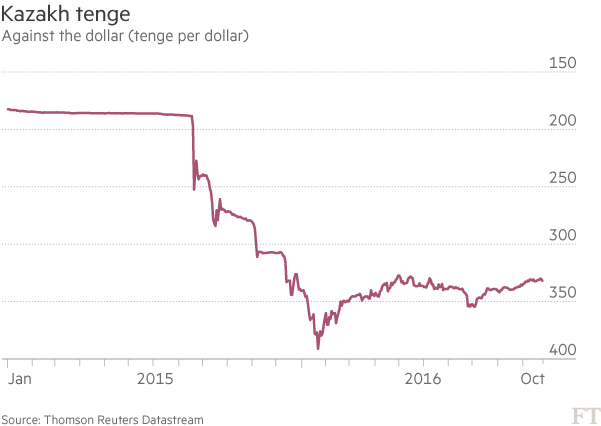
The managed float regime is particularly important. Kazakhstan's central bank does not operate a pure free float; it intervenes to prevent disorderly moves while allowing the tenge to adjust over time to fundamental pressures. This creates a volatility surface with a distinctive skew: out-of-the-money puts on the tenge (i.e., options that pay off if the tenge weakens sharply against the dollar) are frequently underpriced relative to their actual probability of expiring in the money, because the market assumes NBK intervention will cap downside moves. When intervention capacity is stretched — as it was during the 2015 devaluation and again during the commodity downturn of 2020 — that assumption fails, and the mispricing corrects violently.
Conversely, at the other end of the skew, tenge call options (bets on tenge appreciation) often carry inflated premiums during periods of strong commodity revenue, when market participants overestimate the currency's upside momentum. Selling those calls during periods of elevated commodity-driven optimism has historically been a modestly profitable, if nuanced, strategy.
Practical Frameworks for US-Based Traders
Approaching the tenge options market from the United States requires acknowledging several structural realities before placing a single trade.
Access and Instrument Selection
Direct exchange-listed USD/KZT options are not available on US exchanges. Exposure must be constructed through non-deliverable options (NDOs) offered by international banks and brokers with Central Asian market access, or through structured products from regional platforms such as ForexKZ that provide derivatives exposure to the tenge. NDOs settle in dollars, which eliminates convertibility risk and simplifies the tax treatment for US traders filing under IRS rules.
Volatility Cone Analysis
Before entering any position, traders should construct a volatility cone for USD/KZT using at least five years of historical data, segmented by commodity cycle phase. The cone will reveal that current implied volatility in tenge options frequently sits in the lower quartile of the historical distribution during periods of stable oil prices — precisely the environment in which long volatility strategies (straddles, strangles, or simple long puts) offer the most favorable entry points relative to expected realized volatility.
Event-Driven Positioning
Kazakhstan's export calendar functions as a natural volatility clock. NBK monetary policy meetings, OPEC+ production decisions, and quarterly earnings from KazMunayGas all represent identifiable catalyst windows. Positioning in long gamma strategies ahead of these events — when IV has not yet risen in anticipation — allows traders to benefit from volatility expansion without needing to call the direction of the tenge's move.
Skew Exploitation
For traders comfortable with defined-risk structures, risk reversals on USD/KZT offer a compelling expression of the skew mispricing described above. Buying downside tenge puts while selling upside calls in a risk-reversal structure allows a trader to take a net long volatility position with reduced premium outlay, while simultaneously betting that the market's intervention optimism is overdone.
The Liquidity Caveat — and Why It Does Not Disqualify the Trade
The most common objection US traders raise when presented with tenge options is liquidity. The bid-ask spreads in USD/KZT options are wider than those in USD/MXN or USD/BRL, and position sizing must be calibrated accordingly. A trader accustomed to entering and exiting large notional positions in S&P 500 options will need to scale down and accept that the tenge options market rewards patience over speed.
However, the liquidity discount is already reflected in current pricing — and then some. The excess risk premium embedded in tenge options to compensate for illiquidity has historically exceeded the actual cost of executing in the market, meaning that buyers of tenge volatility have, on balance, received more compensation for illiquidity than they have paid for it. This is the inverse of what occurs in highly liquid options markets, where competition among market makers compresses premiums below fair value.
Positioning Central Asia in a Diversified Volatility Portfolio
For US options traders managing a diversified book of volatility exposures, the tenge represents something genuinely rare: a currency whose volatility drivers have a low correlation with the factors that move implied volatility in G10 and mainstream EM pairs. Adding even a modest tenge options allocation to a portfolio dominated by equity index volatility and major-currency options can improve the portfolio's overall Sharpe ratio by introducing an uncorrelated volatility source.
The Kazakhstan market is not a replacement for the trader's existing toolkit. It is a complement — one that rewards the effort of understanding a distinct macroeconomic ecosystem and a central bank with its own logic and priorities. At ForexKZ, we have observed this dynamic play out repeatedly: the traders who take the time to understand how the tenge actually moves, rather than assuming it will behave like every other EM currency, consistently find that the market's inefficiencies are more durable and more exploitable than they initially expected.
The volatility goldmine is not hidden. It is simply waiting for traders who are willing to look past the familiar.