Currency Corridors and Capital Flows: How the SCO's Expanding Trade Network Is Rewriting the Central Asian Forex Map
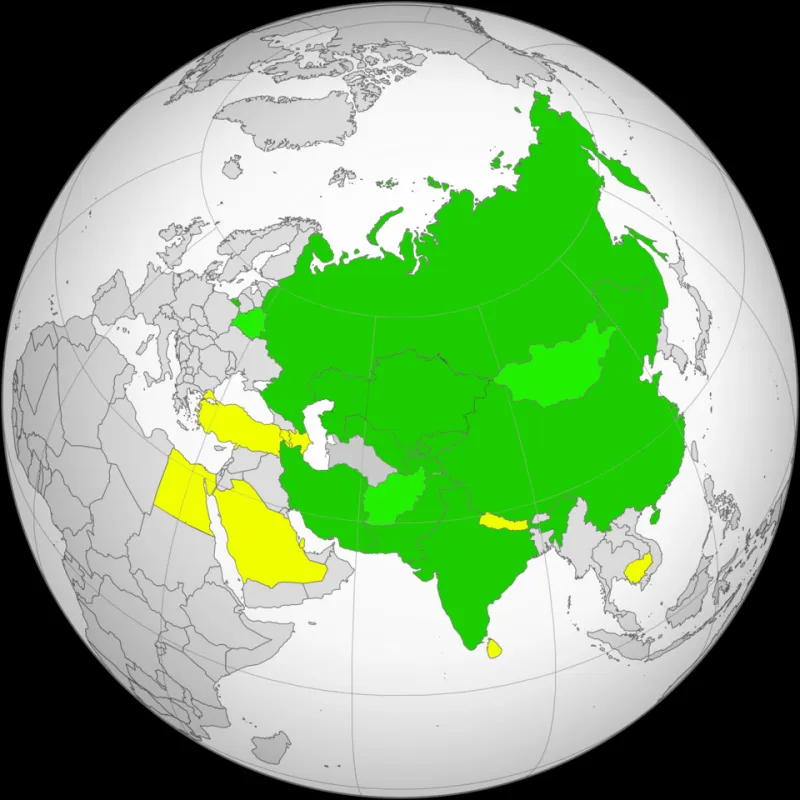
Photo: Firdavs Kulolov, CC BY-SA 4.0, via Wikimedia Commons
There is a moment in every major geopolitical economic shift when the gap between what is happening on the ground and what mainstream financial media is covering becomes wide enough to be genuinely profitable. We may be living through exactly that moment with the Shanghai Cooperation Organization.
The SCO — whose full membership now includes China, Russia, India, Pakistan, Iran, and all five Central Asian republics — has been steadily building the institutional and physical infrastructure of a parallel trade ecosystem. New rail corridors, cross-border payment frameworks, and bilateral currency swap agreements are not abstract diplomatic achievements. They are the plumbing of a new economic architecture, and where new plumbing goes in, currency flows follow. For US forex traders who are paying attention, that means opportunity.
Understanding the SCO's Economic Evolution
Most Americans first encountered the SCO as a security organization — a counterweight to NATO's influence in Eurasia. That framing, while historically accurate, has become increasingly incomplete. Over the past decade, the organization's center of gravity has shifted decisively toward trade facilitation, infrastructure investment, and financial integration.
The numbers are striking. Intra-SCO trade volumes have grown substantially faster than global trade averages over the past five years, driven largely by China's Belt and Road Initiative and a suite of bilateral agreements that reduce friction for goods moving between member states. Infrastructure projects — rail links connecting China to Central Asia, road networks threading through Kazakhstan and Uzbekistan, energy pipelines redirecting flows that once ran exclusively toward European markets — are physically reshaping the commercial geography of the region.
For currency markets, this matters because trade volumes and investment flows are among the most durable long-term drivers of exchange rate behavior. When a country's trade relationships shift structurally, its currency's correlations shift with them.
Which Currency Pairs Are Most Affected
Not all Central Asian currencies are equally exposed to the SCO trade boom. Understanding the differentiated impact requires a brief tour of the region's economic structures.
The Kazakhstani tenge (KZT) occupies the most strategically significant position. Kazakhstan is the SCO's largest Central Asian economy by GDP, the primary transit corridor for goods moving between China and Russia, and the host of major infrastructure investments from both Beijing and Gulf sovereign wealth funds. The tenge's correlation with the Chinese yuan (CNY) has measurably strengthened over the past three years as bilateral trade volumes have grown. Traders who monitor USD/CNY as a leading indicator for USD/KZT directional bias have found a useful — though imperfect — signal relationship.
The Uzbekistani som (UZS) is the region's second-largest currency market and one that has received considerably less analytical attention from Western traders. Uzbekistan has been one of the SCO's most aggressive reformers, opening its economy and attracting investment from China, Russia, and increasingly Gulf states. The som's trajectory is closely tied to remittance flows (Uzbekistan has one of the highest remittance-to-GDP ratios in the world) and to infrastructure investment cycles that the SCO framework is actively accelerating.
Cross-regional pairs — particularly KZT/CNY and KZT/RUB — have become increasingly interesting from an arbitrage standpoint as the volume of direct trade conducted outside dollar-denominated settlement has grown. These are not pairs available on every retail platform, but specialized brokers serving the Central Asian market do offer access.
The Arbitrage Logic: Where the Opportunities Live
The most accessible SCO-related trading opportunities for US-based investors are not exotic or highly technical. They follow a straightforward logic: identify the moments when SCO-driven structural changes in trade flows are not yet fully priced into currency valuations, and position accordingly.
Consider a concrete example. When a major new rail corridor connecting Xinjiang to Kazakhstan's industrial heartland becomes operational, the immediate economic effect is a reduction in freight costs and transit times for Chinese goods entering Central Asia. This structurally increases Chinese export competitiveness in the region, which over time puts modest downward pressure on the tenge relative to the yuan as trade balances adjust. A trader who identifies this dynamic early — by monitoring SCO infrastructure completion announcements, which are public and regularly reported — can position in the USD/KZT or CNY/KZT pair ahead of the broader market's recognition of the shift.
The key analytical discipline here is distinguishing between structural shifts and short-term noise. SCO infrastructure projects operate on multi-year timelines. The currency implications unfold gradually, with periodic acceleration when specific milestones are reached — a new trade agreement ratified, a major corridor inaugurated, a bilateral currency swap facility activated. Building a calendar of these anticipated milestones and mapping their likely currency effects is the core of an SCO-aware trading strategy.
Positioning Ahead of Major SCO Developments
For US traders looking to implement this framework practically, several near-term SCO developments warrant close attention in the current cycle.
First, the ongoing expansion of the SCO's membership and the deepening of its trade facilitation mechanisms is generating increased yuan usage in Central Asian commerce. Any acceleration in yuan internationalization within the SCO zone has direct implications for tenge and som valuations. Monitoring People's Bank of China statements on yuan swap agreements with Central Asian central banks is a useful leading indicator.
Second, energy infrastructure developments — particularly new pipeline capacity and power grid interconnections — periodically create sharp, event-driven moves in the currencies of the countries involved. Kazakhstan's role as a transit state for both hydrocarbons and electricity gives the tenge particular sensitivity to these announcements.
Third, SCO summit communiqués, typically released twice annually, often contain specific language about new trade agreements or investment commitments that carry currency implications. Reading these documents — available in English through official SCO channels — takes less than an hour and can surface material information well ahead of Western financial media coverage.
A Strategic Perspective for the US Trader
It would be intellectually dishonest to present the SCO trade boom as a risk-free opportunity. Geopolitical complexity is inherent to this region. Sanctions risk, regulatory opacity, and the occasional sharp reversal driven by political events are all features of the landscape that any responsible trader must account for.
What we would argue, however, is that these risks are manageable — and that they are already well-understood by the sophisticated investors who have been operating in Central Asian currency markets for years. For US traders accustomed to the relative transparency of developed-market forex, the learning curve is real but not prohibitive.
ForexKZ exists precisely to narrow that curve. Our platform and analytical resources are built for investors who recognize that some of the most compelling currency opportunities in the current global environment are unfolding not in Frankfurt or London, but along the trade corridors connecting Almaty to Beijing and Tashkent to Moscow. The SCO's expanding economic footprint is not a story that Western financial media tells well. That gap between reality and perception is, ultimately, where traders make money.