Ancient Routes, Modern Returns: Positioning Your Forex Portfolio Along Central Asia's Revitalized Trade Corridors
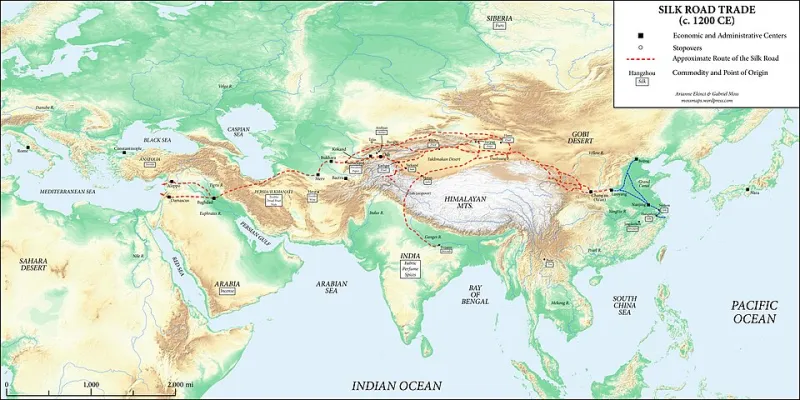
Photo: Gabriel Moss, CC BY-SA 4.0, via Wikimedia Commons
Opinion & Strategy | ForexKZ
There is something historically resonant about the fact that the trade routes connecting China to Europe — paths that once carried silk, spices, and precious metals across the steppes of Central Asia — are once again at the center of a global economic conversation. The modern incarnation of this exchange, formalized through China's Belt and Road Initiative (BRI) and supplemented by a web of bilateral and multilateral trade agreements, is not merely an infrastructure story. It is a currency story. And for US forex traders willing to engage with its implications, it represents one of the more compelling diversification opportunities available in today's market environment.
This is not a conventional market analysis. It is an argument — grounded in macroeconomic evidence — for why understanding Central Asian trade dynamics should be part of every serious forex investor's analytical framework in 2024 and the years ahead.
The Trade Corridor as a Currency Catalyst
To appreciate the forex implications of Central Asia's trade corridor development, it helps to understand the mechanism by which trade reshapes currency demand. When goods move between nations, currencies must move with them. Importers need to acquire the exporter's currency; financing arrangements create cross-border capital flows; infrastructure investment generates sustained demand for local currencies over multi-year project timelines.
Kazakhstan sits at the geographic and economic heart of this dynamic. As the largest landlocked country in the world and one of the BRI's most strategically significant transit nations, Kazakhstan is experiencing a sustained increase in trade-related capital flows. The Trans-Caspian International Transport Route — sometimes called the Middle Corridor — has seen cargo volumes increase substantially as global shippers seek alternatives to northern Eurasian routes. Each container moving through Kazakhstani territory represents a financial transaction with currency implications.
For forex traders, the practical consequence is that the tenge's demand profile is becoming more complex and, arguably, more interesting. Historically driven almost entirely by oil revenues and ruble correlation, the currency is developing additional demand drivers tied to transit fees, foreign direct investment in logistics infrastructure, and the expanding service economy that accompanies trade hub development. This diversification of fundamental drivers is precisely the kind of structural shift that creates medium-to-long-term trading opportunities.
Rethinking Currency Correlations in a BRI Context
One of the most intellectually challenging aspects of trading emerging market currencies in the current environment is that historical correlation data may be less predictive than it once was. This is particularly true in Central Asia, where the BRI has introduced new economic relationships that did not exist a decade ago.
Consider the yuan-tenge relationship. For much of the past two decades, the tenge's primary external correlations were with the Russian ruble and, through the oil price channel, with the US dollar. The yuan's influence was present but secondary. As Chinese investment in Kazakhstani infrastructure deepens and bilateral trade volumes expand, that hierarchy is shifting. Traders who rely exclusively on historical correlation models without accounting for this structural evolution risk misreading the market.
Similarly, the currencies of Uzbekistan, Kyrgyzstan, and Tajikistan are increasingly influenced by their integration into BRI-linked supply chains. The Uzbekistani som, in particular, has attracted growing attention as that country pursues economic liberalization and positions itself as a manufacturing and logistics hub. For traders with the analytical bandwidth to monitor multiple regional currencies, the correlation structures between these markets — and their relationships with the yuan and dollar — offer a rich set of potential positioning opportunities.
At ForexKZ, we track these evolving correlations as a core component of our regional market analysis. Our view is that traders who invest in understanding these relationships now will be better positioned as the markets mature and liquidity improves.
Risk Management in Emerging Market Corridors
Any honest discussion of Central Asian currency trading must address risk management with appropriate seriousness. Emerging markets carry risks that are qualitatively different from those encountered in major currency pairs — and trade corridor dynamics, while broadly constructive for regional economies, do not eliminate these risks.
Political risk deserves particular attention. The governments of Central Asian nations retain significant influence over their currency regimes, and policy decisions — including capital controls, managed float interventions, or sudden shifts in foreign investment policy — can produce sharp, difficult-to-anticipate currency moves. US traders should maintain a clear-eyed awareness that the institutional frameworks governing these markets, while improving, do not yet match the transparency and predictability of OECD-standard regulatory environments.
Liquidity risk is equally important to quantify before entering positions. Bid-ask spreads on tenge pairs and other regional currencies are wider than those available on major pairs, and market depth can thin considerably during periods of regional stress. This means that position sizing must be approached conservatively, and exit strategies should be planned with the assumption that execution during volatile periods may be less favorable than during normal conditions.
That said, risk management in this context is a solvable problem — not a reason for avoidance. Traders who apply disciplined position sizing, use appropriate stop-loss placement calibrated for wider spreads, and maintain sufficient portfolio liquidity to absorb adverse moves can participate in these markets with a risk profile that is well within acceptable bounds for a diversified forex portfolio.
Translating Macroeconomic Trends Into Trading Frameworks
The gap between recognizing a macroeconomic trend and translating it into a profitable trading framework is where many investors lose their way. The BRI's influence on Central Asian currencies is real, but it operates on timescales that do not map neatly onto short-term technical setups.
Our recommendation at ForexKZ is a layered approach. At the macro level, traders should develop a thesis about the medium-term trajectory of regional trade volumes and their currency implications — a framework that might span six to eighteen months. Within that macro view, tactical entries can be identified using technical analysis of tenge and regional currency charts, with particular attention to how currency pairs respond to commodity price moves, regional economic data releases, and BRI-related policy announcements.
This kind of multi-timeframe approach is not unique to emerging markets, but it is especially well-suited to them. The macro trends in Central Asian trade corridors are sufficiently durable to provide a fundamental anchor for positions, while the shorter-term volatility provides the entry and exit opportunities that make the trade executable.
A Strategic Moment for Forward-Thinking Investors
The revitalization of Central Asia's trade corridors is not a speculative narrative — it is a documented economic reality, supported by infrastructure investment data, trade volume statistics, and capital flow records. What remains underappreciated, particularly among US investors, is the degree to which this reality is already reshaping currency dynamics in the region.
The traders who benefit most from structural market shifts are typically those who engage early, before the opportunity becomes consensus. ForexKZ exists to give US investors the regional intelligence and market access necessary to be among that early cohort. The Silk Road once connected civilizations through commerce. Its modern financial equivalent is connecting forward-thinking investors to returns that most of their peers have yet to discover.