Uranium, Oil, and Rare Earths: Reading Kazakhstan's Export Calendar as a Forex Trading Clock
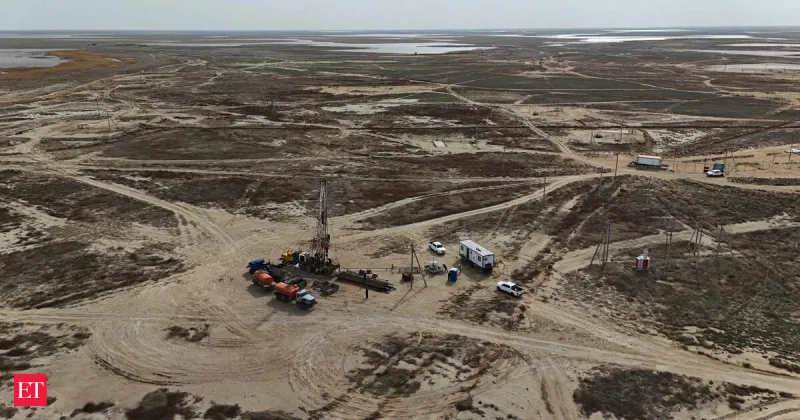
Photo: Kazakhstan uranium oil mining commodity export industrial landscape, via img.etimg.com
In currency trading, edge comes in many forms. Some traders find it in macroeconomic modeling. Others find it in technical pattern recognition or order flow analysis. A smaller but consistently profitable group finds it in something more fundamental: understanding the physical economic activity that actually drives a currency's supply and demand at the most basic level.
For those traders, Kazakhstan's tenge presents an unusually clean case study. The country's export base is concentrated enough — dominated by oil, uranium, and an expanding portfolio of critical minerals — that the cyclical patterns in those commodity flows create identifiable, repeating signatures in the tenge's behavior. This is not a theoretical observation. It is a practical trading framework, and US traders are, by and large, not yet using it.
Kazakhstan's Commodity Profile: A Primer for US Traders
Before discussing trading strategy, it is worth establishing the factual foundation. Kazakhstan is not a minor player in global commodity markets. It consistently ranks among the top three global producers of uranium, supplying roughly 40 to 45 percent of the world's mined uranium output through Kazatomprom, the state-owned mining giant. Its oil production, centered on the massive Tengiz, Kashagan, and Karachaganak fields, makes it one of the largest crude exporters in the post-Soviet space. And its reserves of chromium, manganese, copper, zinc, and a growing list of rare earth elements have drawn increasing attention from both Chinese and Western industrial buyers navigating supply chain diversification.
Collectively, these commodities account for the vast majority of Kazakhstan's export revenue. That concentration is the analytical foundation of everything that follows. When export revenue rises, foreign currency inflows strengthen the tenge. When it contracts, the currency faces depreciation pressure. The question for traders is whether those cycles are predictable enough to trade — and the evidence suggests they are.
Oil's Seasonal and Geopolitical Rhythms
Kazakhstan exports its crude primarily through the Caspian Pipeline Consortium (CPC) route to the Black Sea port of Novorossiysk, with secondary flows through Russian and Chinese pipeline infrastructure. This routing geography matters enormously for traders because it introduces a layer of geopolitical risk — and periodic disruption — that creates sharp, tradable tenge moves.
CPC pipeline disruptions, which have occurred multiple times in recent years due to storm damage, technical failures, and, more recently, geopolitical complications related to the Russia-Ukraine conflict, produce immediate and measurable tenge weakness. The pattern is consistent: disruption news precedes a tenge sell-off, followed by a recovery as export flows normalize. US traders who monitor CPC operational status — information that is publicly available and regularly reported in energy industry sources — have a genuine informational advantage over participants who track only currency-market data.
Beyond disruption events, Kazakhstani crude exports also exhibit seasonal patterns tied to global energy demand cycles and OPEC+ production quota negotiations, in which Kazakhstan participates as an associated producer. The fourth quarter, when Northern Hemisphere energy demand typically peaks, has historically corresponded with periods of firmer tenge performance when oil prices are supportive. This is not a rigid rule, but it is a directional tendency worth incorporating into a seasonal positioning framework.
Uranium's Unique Cycle and Its Tenge Implications
Uranium is where Kazakhstan's commodity story becomes genuinely distinctive from a forex perspective. No major currency pair offers meaningful exposure to uranium price movements. The commodity is thinly traded, its pricing is largely negotiated through long-term contracts rather than real-time spot markets, and its connection to global nuclear energy policy creates demand dynamics that operate on a completely different timeline than oil or metals.
For the tenge, uranium's importance is both structural and cyclical. Structurally, Kazatomprom's export revenues represent a significant and growing share of Kazakhstan's foreign currency earnings. Cyclically, the uranium market has experienced a meaningful bull phase driven by renewed global interest in nuclear power as a low-carbon baseload energy source. That bull phase — which accelerated notably from 2021 onward — has been a quiet but persistent tailwind for the tenge that most US forex traders have not priced into their analysis.
The practical implication is this: when uranium spot prices rise and Kazatomprom announces strong production and export volumes — typically in quarterly operational updates — the tenge tends to exhibit relative strength that is not always explained by concurrent oil price movements or National Bank policy signals. Traders who track Kazatomprom's operational disclosures alongside spot uranium pricing have an additional signal layer that is essentially invisible to analysts focused solely on traditional forex drivers.
Critical Minerals: The Emerging Third Leg
The third component of Kazakhstan's commodity export story is the least developed but potentially the most significant over a medium-term horizon. Rare earth elements and critical minerals — including lithium, cobalt precursors, and various industrial metals — have become a strategic priority for both the United States and the European Union as they seek to reduce dependence on Chinese supply chains.
Kazakhstan has positioned itself aggressively to capture a share of this demand. Multiple processing and extraction agreements with Western companies and governments have been announced in recent years, and the country's geological endowment is genuinely substantial. As these flows develop from exploratory agreements into actual export revenue, they will add a third cyclical driver to the tenge's commodity correlation profile.
For US traders, the early-stage nature of this dynamic actually creates an opportunity. The market has not yet fully priced the tenge as a critical minerals currency. As export revenues from these commodities grow, the tenge's correlation with critical mineral pricing should strengthen — and traders who establish that analytical framework now will be positioned ahead of the broader market recognition.
Building the Trading Clock
Putting these elements together into a practical framework requires integrating several data streams that most forex traders do not currently monitor. The calendar should include: quarterly Kazatomprom production reports (typically released in January, April, July, and October); monthly CPC pipeline throughput data; OPEC+ meeting schedules and Kazakhstan's quota compliance record; and periodic announcements from Kazakhstan's Ministry of Energy regarding export volumes and infrastructure developments.
The approach is not about predicting exact price levels. It is about identifying periods of elevated probability for tenge strength or weakness based on the convergence or divergence of these commodity signals. When oil prices are firm, the CPC pipeline is operating at capacity, and Kazatomprom reports strong quarterly output simultaneously, the tenge's fundamental backdrop is as supportive as it gets. When two or more of those factors turn negative at once, the currency's vulnerability increases materially.
This kind of commodity-cycle analysis is labor-intensive relative to simply trading EUR/USD off a Reuters terminal. But for US traders seeking genuine diversification and an analytical edge that is not crowded with competing participants, Kazakhstan's export calendar offers something increasingly rare in modern markets: a signal that most of your competition is not yet reading.