Beneath the Surface: How Kazakhstan's Inflation Distortions Are Creating Invisible Forex Signals US Traders Keep Missing
Every experienced forex trader knows that official data and market reality rarely occupy the same space. In developed markets, the gap between the two is usually narrow enough to be manageable. In emerging markets, particularly those with complex commodity dependencies and evolving statistical methodologies, that gap can be wide enough to swallow an entire trading thesis whole.
Kazakhstan sits squarely in the second category. And right now, the distance between what the Bureau of National Statistics reports as consumer price inflation and what domestic market participants are actually experiencing is generating distortions that carry real consequences for anyone trading the tenge from abroad.
What the Official Numbers Are Actually Measuring
Kazakhstan's headline Consumer Price Index is constructed using a basket of goods and services weighted according to national consumption surveys. On paper, this is standard practice. In execution, however, the methodology reflects a consumption profile that skews toward formal retail channels, government-administered prices, and urban centers — particularly Almaty and Astana.
The practical effect is a CPI reading that systematically underweights price pressures in informal markets, rural areas, and sectors where state subsidies create artificial price ceilings. Energy, certain food staples, and utility costs are among the categories most affected. When those subsidies shift — either through policy adjustment or through quiet administrative changes — the headline figure moves far less than the underlying reality warrants.
For a US trader accustomed to working with the Bureau of Labor Statistics data, where methodological debates center on relatively minor issues like owners' equivalent rent, this represents a fundamentally different level of structural opacity.
The Commodity Price Transmission Problem
Kazakhstan's economy is deeply commodity-dependent, with oil and gas revenues accounting for a substantial share of export earnings and government receipts. When global energy prices rise, the tenge typically strengthens. But the internal transmission of those commodity price movements into domestic inflation is neither immediate nor linear.
Fuel subsidies, price controls on basic goods, and the government's willingness to absorb commodity cost increases through state-owned enterprises all create lags. The result is a delayed inflation signal — one that eventually breaks through when fiscal constraints force policy adjustments, but that remains invisible in official data for months beforehand.
Traders who watch only the published CPI are, in effect, watching a lagging indicator of a lagging indicator. By the time headline inflation reflects the true pressure that has been building in domestic markets, the tenge has often already begun moving in ways that appear disconnected from the official data narrative.
Reading the Informal Market as a Leading Indicator
So where should US traders look instead? The answer lies in several alternative data streams that, while less convenient than a Bloomberg terminal feed, offer considerably more signal.
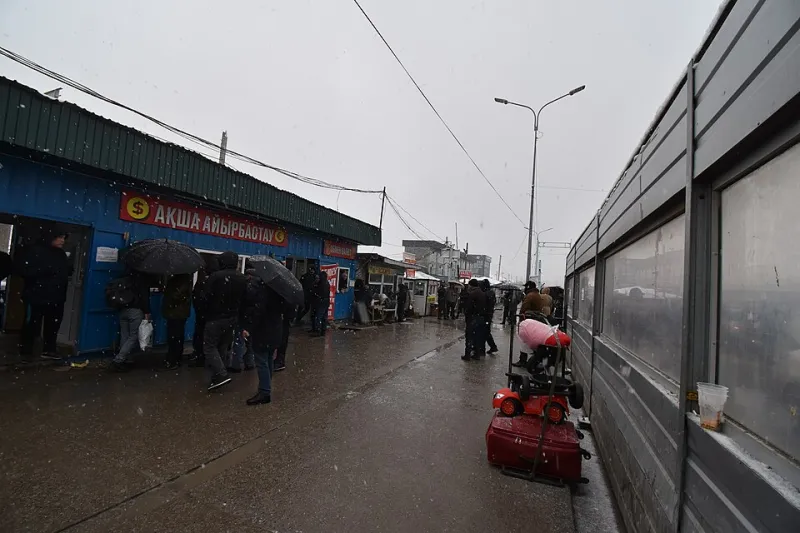
Bazaar price surveys — informal but surprisingly consistent tracking of goods prices in Kazakhstan's major open-air markets — have historically led official CPI readings by four to six weeks. The Almaty bazaar network, in particular, functions as a real-time inflation gauge for food and household goods that the formal statistical apparatus simply cannot capture at the same speed.
Remittance flows offer another angle. Kazakhstan receives significant worker remittances, and the volume and frequency of those transfers tend to reflect purchasing power conditions on the ground more honestly than any government release. A sustained increase in remittance frequency from Kazakhstani workers abroad often signals domestic cost-of-living pressure that hasn't yet surfaced in published data.
Finally, credit card transaction data from Kazakhstan's major retail banks — some of which is published in aggregate form through central bank statistical releases — provides a consumption velocity signal. When transaction volumes rise faster than official retail sales figures suggest, informal price inflation is typically the explanation.
How the Distortion Creates Tradeable Asymmetry
The forex implication of all this is straightforward in theory, though it requires patience and discipline to execute in practice. When real inflation is running materially above reported inflation, the National Bank of Kazakhstan faces a policy dilemma it cannot fully acknowledge in public communications. Rate decisions that appear calibrated to official data may be quietly influenced by ground-level price pressures that policymakers are tracking through their own internal channels.
This creates a scenario where tenge interest rates are effectively set in response to an inflation reality that the market isn't pricing — at least not until the gap becomes too large to ignore. For US traders positioned in tenge-denominated instruments, the eventual policy correction, when it comes, tends to arrive faster and with greater magnitude than consensus forecasts anticipate.
The asymmetry here is meaningful. Traders who have done the work to understand real inflation dynamics can position ahead of policy shifts. Those relying solely on official data find themselves reacting after the fact, typically at worse entry points.
The Dollarization Feedback Loop
There is a further complication worth understanding. Kazakhstan's economy retains a significant degree of informal dollarization — a legacy of the currency crises of the 1990s and the sharp tenge devaluations of 2015 and 2016. A meaningful portion of domestic savings, real estate transactions, and large-ticket purchases are still denominated in US dollars, even as official policy encourages tenge usage.
When real inflation runs hot, this dollarization tendency intensifies. Kazakhstani households and businesses shift more of their asset holdings into dollars as a store of value, creating demand pressure on the USD/KZT pair that precedes any formal policy response. This behavioral signal is visible in central bank reserve data and in the spread between official and informal exchange rates — both of which are publicly accessible, though they require some effort to locate and interpret correctly.
For US-based traders, recognizing this feedback loop means understanding that tenge weakness during high-inflation periods is not simply a mechanical response to interest rate differentials. It reflects a deeper behavioral dynamic rooted in historical experience with currency instability — one that amplifies moves beyond what a purely technical or macro framework would suggest.
Practical Implications for Positioning
None of this suggests that trading the tenge based on alternative inflation signals is straightforward. Kazakhstan's markets remain relatively illiquid by global standards, and the information advantages available to on-the-ground participants are real. US traders operating remotely face genuine information asymmetries that no amount of analytical rigor can fully eliminate.
What it does suggest is that traders who limit their analysis to official statistics are working with an incomplete picture. Supplementing CPI data with bazaar price surveys, remittance flow trends, and central bank reserve movements provides a materially richer view of the inflation dynamics actually driving tenge behavior.
The traders consistently finding edge in Central Asian forex markets are, almost without exception, the ones willing to go beyond the headline number — to ask not just what the statistics bureau reported, but what those numbers are failing to capture. In Kazakhstan's case, that question is never trivial. And right now, the answer is more consequential than it has been in some time.