Depth Charges: What the KASE Order Book Reveals Before the Official Fix Does
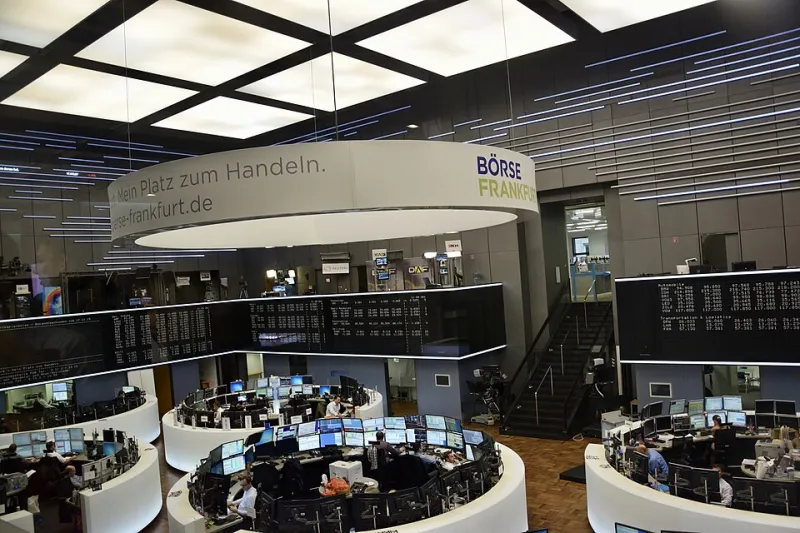
Photo: Ank Kumar, CC BY-SA 4.0, via Wikimedia Commons
There is a comfortable habit among US desks that touch Central Asia: pull the National Bank of Kazakhstan's official rate, compare it to yesterday's print, note the percentage change, and consider the currency understood. That habit is not wrong so much as insufficient. The official rate is a settlement reference, not an execution price, and the gap between the two widens precisely when it matters most.
A Fix Is a Statement About the Past
The official rate is derived from trading on the Kazakhstan Stock Exchange during defined sessions and published once per business day. It is an accounting anchor used for contracts, tax calculations, and reporting. What it is not is a guarantee that any given size can be transacted at or near that level at the moment you need it.
This distinction is old news in emerging-market FX, but it is routinely underestimated in Kazakhstan because the fix is unusually smooth. A tidy, low-volatility official series creates an impression of frictionless liquidity. The order book frequently disagrees.
Anatomy of a Thin Book
KASE tenge trading is concentrated. Market-making obligations exist, and the largest domestic banks are reliable participants, but the number of institutions willing to show meaningful size at any given moment is small by the standards of a G10 pair. When two or three of those participants step back — because of a balance-sheet constraint, a risk-limit review, or simply a domestic funding squeeze — the visible book does not collapse. It thins. And thinning is harder to see than disappearance.
Three signatures are worth monitoring.
First, the spread between the best bid and best offer widens modestly but persistently, often by a few basis points rather than a dramatic jump. Second, the depth available within a reasonable distance of mid shrinks, so that what used to be a manageable clip now requires walking the book. Third, the correlation between the official rate and intraday prints loosens, with the market trading at a visible premium or discount to the fix.
None of these signals appear in a rate chart. All of them appear in execution data.
The Slippage Arithmetic
Consider a US institution that needs to convert the equivalent of a few million dollars into tenge on a Tuesday. In a deep market, the cost is the spread plus a small market-impact term. In a thin market, the cost curve is convex: the first million executes near mid, the second costs noticeably more, and the final tranche can clear several tens of basis points away from where the process began.
Annualized, a persistent twenty-basis-point execution shortfall on a revolving exposure is not a rounding error. It is a structural drag that can exceed the entire expected return of a short-duration carry strategy. This is the liquidity mirage in its purest form: a stable official rate that flatters backtests while quietly taxing live execution.
Session Logistics and Settlement
The operational details matter as much as the microstructure. Kazakhstan's trading day runs well ahead of New York, and the practical window in which a US desk can act on Almaty liquidity overlaps only partially with the hours when its own risk committee is awake. Confirm current session timings and value dates with your executing counterparty rather than assuming a template inherited from another emerging market — settlement conventions, cutoffs, and holiday calendars in Kazakhstan have their own logic.
There is also a documentation layer. Access routes into onshore tenge vary in their depth: some intermediaries provide genuine two-way pricing in size, others aggregate and route, which introduces a second layer of latency and a second set of fees. Understanding which type of venue you are actually facing changes your expectations about fill quality.
Where the Mirage Appears
Liquidity stress in the tenge rarely announces itself with a headline. It tends to arrive alongside three recurring conditions: month-end and quarter-end balance-sheet management by domestic banks, large scheduled conversions related to the state budget or the national fund, and periods of elevated uncertainty around the base rate decision calendar.
In each case, the official rate may barely move for days while execution costs climb. Traders who monitor only the fix conclude that the market is calm. Traders who monitor their own fills conclude that it is expensive. Both are describing the same market from different vantage points.
An Execution Checklist for US Desks
A disciplined approach contains five habits. Request indicative depth, not just indicative prices. Break large orders into tranches with defined maximum slippage tolerances. Record realized execution versus the official rate as a standing metric, and review it monthly. Avoid scheduling structural conversions on the days immediately surrounding quarter-end or major fiscal deadlines. And maintain a second access route, because the value of a backup channel is highest on the day the primary one narrows.
The Takeaway
Kazakhstan's currency market has matured considerably, and its infrastructure now supports institutional-scale activity that would have been difficult a decade ago. But maturity is not the same as depth. For US investors, the practical implication is straightforward: treat the official rate as the beginning of your analysis rather than the end of it, and let your own execution data — not the published fix — tell you what tenge liquidity is genuinely worth on any given day.